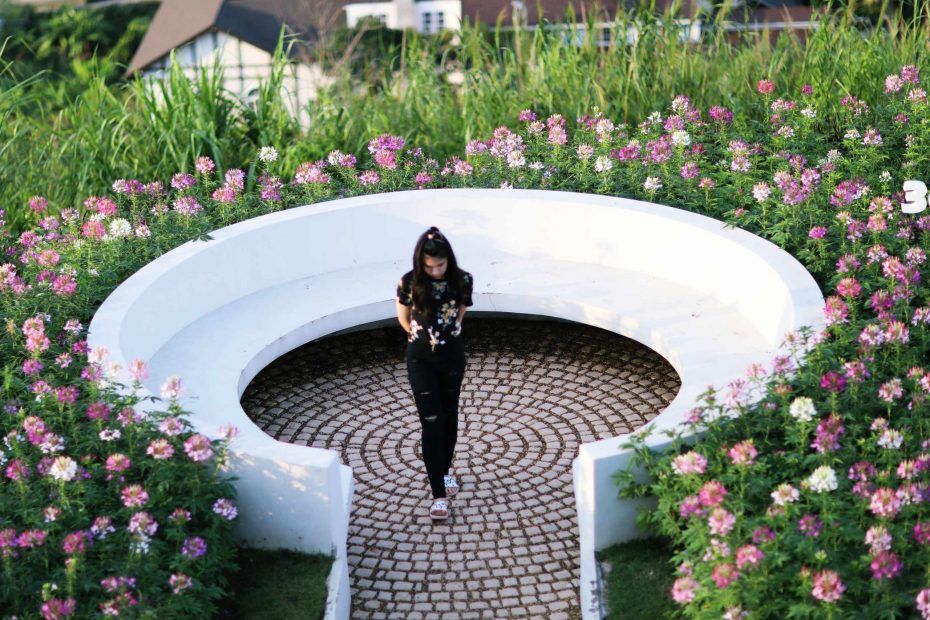
A birdbath, bench, colorful container, miniature tree, sculpture, curving border, and masses of ornamental grasses can all be excellent garden elements. Trouble starts when each one wants your attention at the same time. In a small garden, too many elements create restlessness. A focal point gives your eye somewhere to rest; when you have a clear focal point paths, planting beds, sitting areas and borders look more cohesive.
Your focal point needn’t be flashy or ornate. It can be the container near the back door, a small tree at the end of the line of vision, a bench surrounded by shrubs, a textural planting group, or a calm edging that leads the eye toward a sitting area. What is important is how it functions within your plan. It should help the overall design, not just fill an empty corner. To find the best place for one, look from where your garden is usually seen, from the back door, a kitchen window, the garden gate, a spot on the deck, a seating area, a pathway, or where you stand in the garden.
This is where many early garden plans go awry. A novice plants one garden gem in every corner, as each corner appears empty. The garden has no rest; the eye flits from focal point to focal point and the planting beds don’t look like parts of a whole design, but rather like displays in an art gallery. Leaving some areas understated can strengthen the focal point. Edging with repetitive form or textural plants, a wide swath of mulch or low planting can support the focal point, not compete with it.
Experiment with the focal point on a design sketch before you place anything on the soil. Map out the property outline, doors, windows, paths, existing trees and sitting areas. Then choose your favorite viewpoint. Draw a dot somewhere in the garden where you want your focal point to be. Now trace the way your eye will move from your viewing point to that dot. Is there a path that draws your attention to it? Is there an edging that frames it? Will the plants around it block it when they’re fully grown? Is your focal point behind some garden chaos? Is it located where no one will want to look? If so, you may want to move it.
Planting around your focal point should enhance it, not detract from it. If the focal point is a small tree, the plants nearby may need to be smaller, softer in texture or with a limited color palette to set off the tree. If the focal point is a bench, the planting may surround a sitting area but provide enough access for getting to and from the bench and for tending the plants around it. If the focal point is a bold container, plants nearby may need a quiet hue of green, finer texture or repetitive leaf form to compliment it. The goal isn’t to make everything simple, it’s to decide what speaks first.
Consider how your focal point works during the seasons. A focal point that is beautiful for one month may not support the garden through the rest of the year, unless your plan has enough support in other areas. A compact evergreen shrub, a strong plant form in a container, a pathway that leads the eye, or a bench with a good view from afar will provide a base for the design. If you have chosen a seasonal focal point, use your base plan to ensure enough structure exists in the rest of the garden during non-seasonal times.
When adding an item to your garden plan, hide the existing focal point with your fingertip. If the rest of the design falls apart, your focal point has helped you with a good function. If the design remains intact, the focal point may just be decorative clutter. A good focal point helps support your design and can make your garden much more restful than one more pretty thing.